1
Landside — before security
Check-in desks, a cafe and small shops. The arrivals hall opens onto the taxi rank, the bus stop and the car-hire desks.
HER has one compact passenger terminal with almost everything on the main level — check-in, security, gates, shops, the car park and transport are all here, so you will not get lost between concourses.
Crete has three airports in use. Heraklion (HER) is the busiest and the one this page is about; Chania (CHQ) is 135 to 145 km away at the western end of the island; Sitia (JSH) in the east is small and seasonal. Every number on the map is the road distance from Heraklion Airport, so you can see at a glance whether your resort is a twenty-minute drive or a two-hour one.
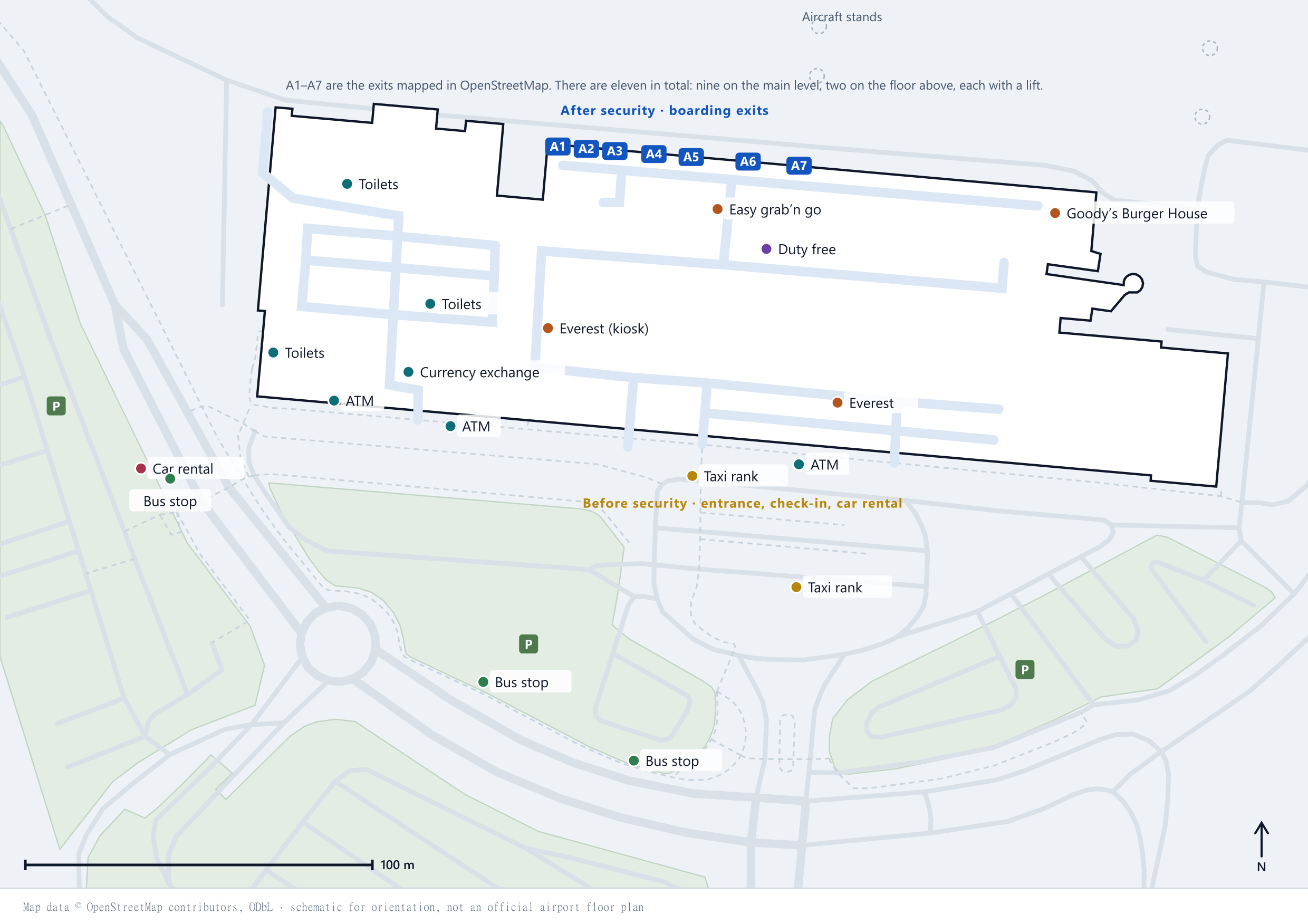
HER has one terminal, about 280 by 110 metres. You enter from the forecourt side, where check-in and the car rental counters are; security is in the middle of the building; the boarding exits run along the far side, facing the aircraft. Everything below is drawn to scale from OpenStreetMap data — it shows where things sit relative to each other, not an official floor plan.
Download this plan (PNG) — The airport publishes no official PDF, so this is our own drawing — save it or print it as you like.
HER is one compact terminal — a short, straight walk from the car park through check-in and security to the gates.
Check-in desks, a cafe and small shops. The arrivals hall opens onto the taxi rank, the bus stop and the car-hire desks.
Boarding gates, the duty-free and shops, cafes and food, and the lounges. The gates are a short walk from security.
The car park is directly in front of the terminal, a two-to-three minute walk from the doors.
Almost the whole terminal is on one main level, so walking distances are short even at the summer peak. Two of the eleven departure exits are on the floor above and have their own lifts.
Signage is clear and bilingual in Greek and English throughout the terminal.
The main level and short distances make HER straightforward with trolleys, pushchairs or reduced mobility.
A new, larger airport is under construction inland at Kastelli to replace the current site in the coming years.
Updated
Heraklion International Airport “Nikos Kazantzakis” (HER) is one compact passenger terminal with almost everything on the main level, which is why it needs less map-reading than its passenger numbers suggest: 9,384,233 travellers came through in 2024, up 7.6 % on the year before. There are no concourses to choose between and no shuttle between piers. Everything below is the layout in words, the position of the airport on Crete, and what you actually walk past in each direction.
HER is on the north coast, about 5 km east of Heraklion city centre, at 35°20′23″N 25°10′49″E and 35 m above sea level. The coastal road runs west into the city and east towards the resorts, which is the only orientation most arrivals need: the sea is on one side, the hills on the other.
Approximate road distances from the terminal, which are what matter when you are deciding between a taxi, the bus and a transfer:
For what each of those costs by taxi, bus or transfer, see the transport guide; for the city specifically, getting from the airport to the city centre.
A common reason people look for a map of “Crete airport” is to work out which one they should be flying into, because the island has more than one:
A fourth is on the way: a new airport is under construction at Kastelli, 39 km south-east of Heraklion, intended to replace the current site. Its opening date has moved more than once, so treat any specific year you read with caution. Until it opens, everything on this page describes the coastal Nikos Kazantzakis terminal.
Several travel sites offer a “Heraklion Airport terminal map PDF”. Those are their own redrawings, not an official document, and they go out of date whenever a shop moves or a gate is renumbered. We do not reproduce or host an airport plan here either: the terminal layout belongs to the airport, not to us.
What works better in practice is the sequence in words, below. Inside the terminal the signage is bilingual, Greek and English, and because almost everything is on the main level you can usually see the next step from where you are standing.
What you pass through, in order, on the way out:
The terminals page covers the departures and arrivals halls in more detail.
In the other direction the order is: aircraft or apron bus to the terminal, then passport control if you are arriving from outside the Schengen area, then baggage reclaim, then the arrivals hall.
The arrivals hall opens straight onto the forecourt, and everything you need is within sight of the doors: the taxi rank at the kerb, the city bus stop a short walk to the right, the car-hire desks, and the parking area opposite. There is no metro and no train, because Crete has no railway at all.
The terminal splits into two zones, and the split matters more than any floor plan. Landside is everything before security: check-in, the cafe, car hire, the exits, the greeters waiting for arrivals. Airside is everything after: gates, duty-free, the lounges, the bulk of the food. Left luggage and the meeting points are landside, so bags going into storage for a few hours have to be dropped before you go through (see the left luggage page). Crossing from landside to airside is one-way; plan the last coffee, the last cash withdrawal and the last goodbye accordingly.
The airport works two runways: the main strip is 2,714 m long and takes the jets, alongside a shorter 1,566 m one. It is a shared civil and military site owned by the Greek State, which is why you may see aircraft on the apron that have nothing to do with your flight.
Ten million passengers a year through one compact terminal is what produces the summer crush: the building is compact and the walking distances are short, but at the morning and evening departure peaks the queues at security are the bottleneck, not the distances. Work backwards from how early to arrive rather than from how long it takes to walk to the gate.
Short distances make HER straightforward with trolleys, pushchairs or a wheelchair: there are no long inter-terminal transfers and no unavoidable stairs between check-in and the gates. Assistance is free but has to be requested through your airline in advance, normally at least 48 hours before the flight. The details are on the reduced mobility page.
Where is Heraklion Airport?
On the north coast of Crete, about 5 km east of Heraklion city centre, at 35°20′23″N 25°10′49″E.
How many terminals does Heraklion Airport have?
One terminal. Almost everything is on the main level, and two of the eleven departure exits are on the floor above.
Is there an official Heraklion Airport map PDF?
The plans offered as “official PDFs” by travel sites are their own redrawings. For a terminal this compact the sequence of check-in, security, passport control and gates is more useful than a floor plan.
How many airports does Crete have?
Three in use: Heraklion (HER), Chania (CHQ) at the western end and Sitia (JSH) in the east. A replacement for Heraklion is being built at Kastelli.
How many runways does Heraklion Airport have?
Two. The main one is 2,714 m long and the second 1,566 m.
Where is the car park?
Directly in front of the terminal, a two to three minute walk from the doors.
Where are the shops and restaurants?
Mostly airside, after security, with a cafe and small shops landside as well.
Is there a train to Heraklion Airport?
No. Crete has no railway; the options are the city bus, a taxi, a pre-booked transfer or a hire car.
Pre-book a private transfer with GetTransfer — fixed price, door-to-door, English-speaking driver.
Partner service, not operated by the airport. We may earn a commission from bookings at no extra cost to you.